PhD Candidate | M.S. (Pharm.) Medicinal Chemistry
National Institute of Pharmaceutical Education and Research (NIPER), Mohali
Computational medicinal chemist specializing in AI-driven drug discovery and multi-target drug design. My research focuses on developing novel therapeutics for Alzheimer's disease using advanced machine learning, deep learning, and network pharmacology approaches.
Pharmaceutical sciences and computational drug discovery training
Pharmacoinformatics
National Institute of Pharmaceutical Education and Research (NIPER), Mohali
Guide: Prof. Prabha Garg, Professor
Medicinal Chemistry
National Institute of Pharmaceutical Education and Research (NIPER), Raebareli
Thesis: Design, Synthesis and In Silico Studies of Coumarin Derivatives as Multi-targeted Anti-Alzheimer's Agents
Advisor: Dr. Gopal Lal Khatik, Assistant Professor
Pharmaceutical Sciences
Sunder Deep College of Pharmacy, Ghaziabad
Dr. APJ Abdul Kalam Technical University, Lucknow
Computational approaches to drug discovery and development
Machine learning and deep learning applications in molecular property prediction and drug design
Structure-based and ligand-based drug design using molecular modeling and docking
Design and optimization of compounds targeting multiple disease pathways simultaneously
Development of novel therapeutics targeting acetylcholinesterase and BACE1 enzymes
Systems biology approaches to understand drug-target-disease interactions
Quantitative structure-activity/property relationships using statistical and ML methods
GNN architectures for molecular graph-based learning and interaction prediction
VAE and other generative models for de novo molecular design and optimization
Peer-reviewed research articles and intellectual property
Biotechnology Reports
Journal of Biomolecular Structure and Dynamics
ChemistrySelect
Central Nervous System Agents in Medicinal Chemistry
Journal of Heterocyclic Chemistry
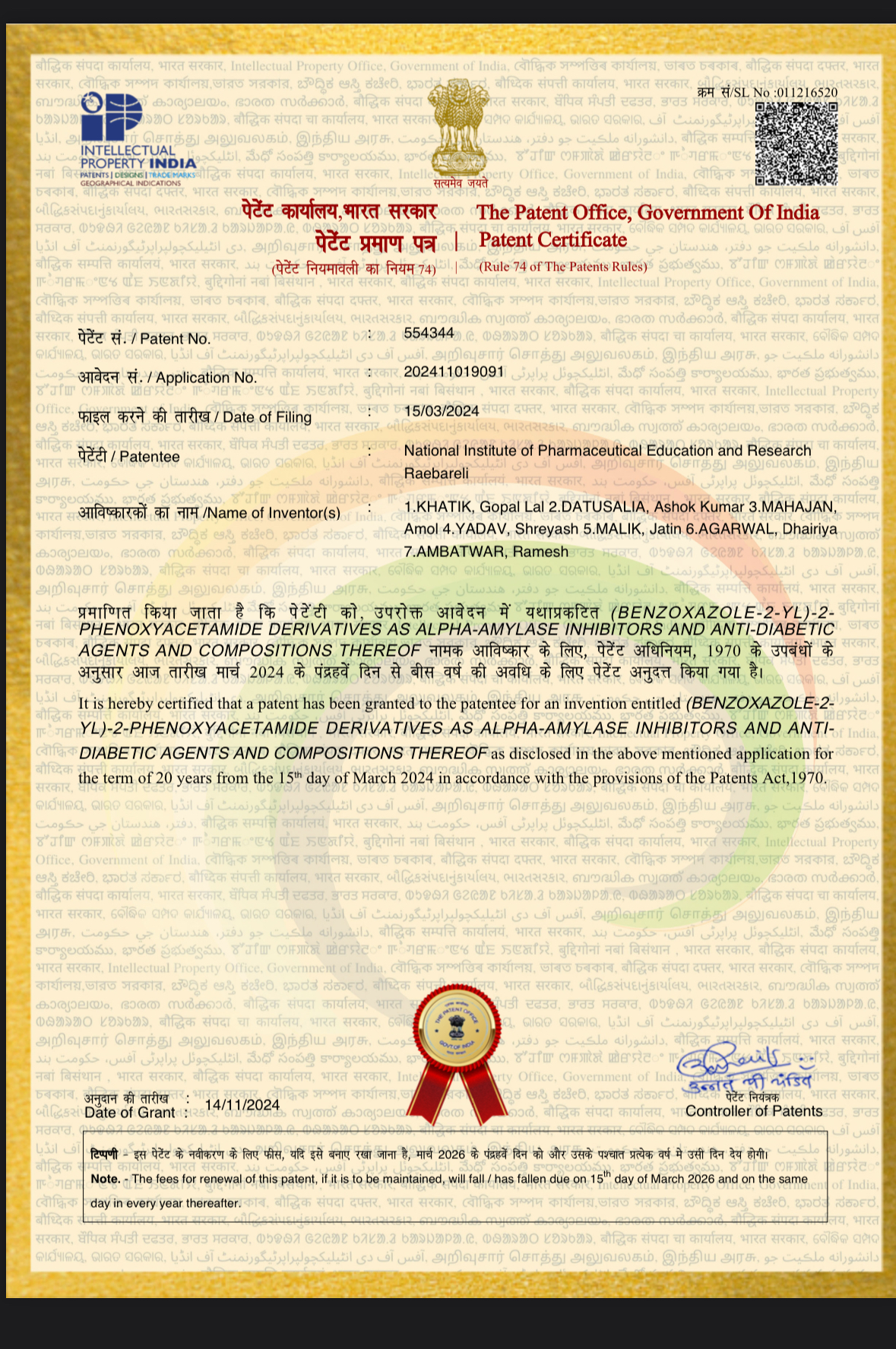
Indian Patent Office
Computational chemistry tools, AI models, and drug discovery pipelines
Machine learning-based prediction of cardiotoxicity for drug candidates. Employs molecular descriptors and fingerprints to classify compounds by cardiac safety risk, aiding early-stage drug safety assessment.
Dockerized GROMACS environment for reproducible molecular dynamics simulations. Provides a ready-to-use containerized setup, eliminating complex installation dependencies for MD simulation workflows.
3D-VAE driven molecular repurposing framework. Leverages Variational Autoencoders with 3D molecular representations to identify existing drugs for new therapeutic indications through latent space exploration.
Classification model for Pks13 inhibitors β a key target for tuberculosis drug discovery. Uses machine learning to predict inhibitory activity of compounds against the Pks13 enzyme of Mycobacterium tuberculosis.
AI-powered chatbot for interacting with research papers. Upload PDFs and ask questions in natural language β the chatbot extracts, processes, and retrieves relevant answers using NLP and retrieval-augmented generation.
Deep learning approach for diagnosing Alzheimer's disease from medical imaging data. Utilizes convolutional neural networks to classify brain scans and assist in early-stage AD detection and severity staging.
Cholinesterase inhibitor prediction using machine learning models. Predicts the inhibitory potential of compounds against acetylcholinesterase (AChE) and butyrylcholinesterase (BChE) β key targets in Alzheimer's therapy.
Computational tools and laboratory techniques
Open to research collaborations and opportunities
+91-9015064028
06, Rajeev Puram Dasna
Ghaziabad, UP 201015, India